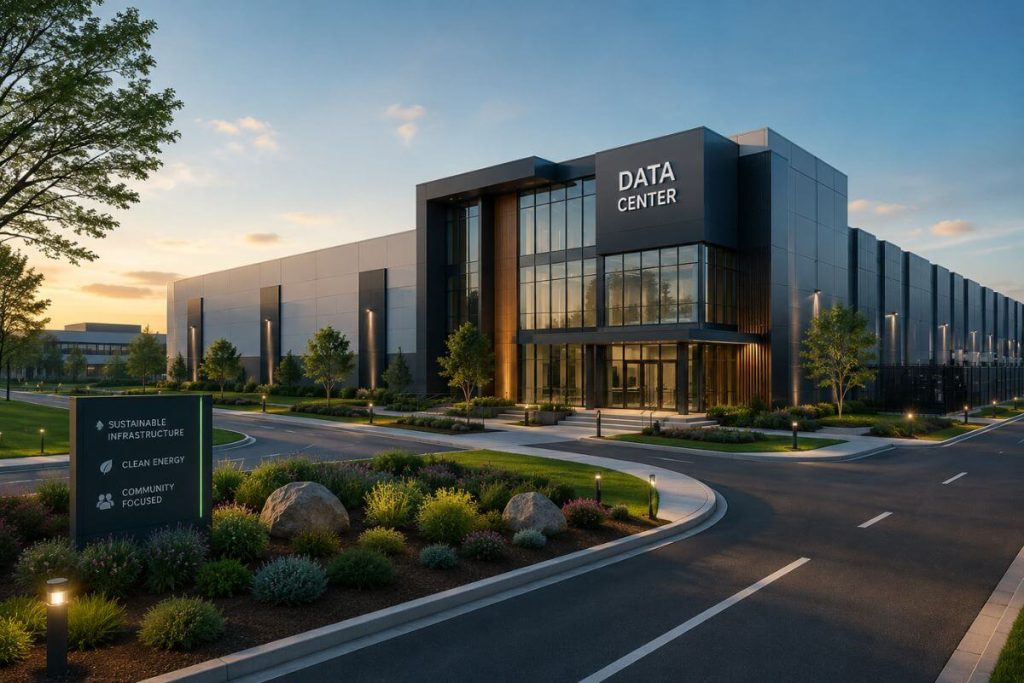
A prettier data center may be easier for a community to accept. A smaller one may be easier to live with.
As demand for AI infrastructure accelerates, developers are paying more attention to how each new data center building fits into the surrounding community. Some architects are moving away from the familiar windowless industrial box and designing facilities that resemble technology campuses, civic buildings, or even art museums. Landscaping, public spaces, and locally appropriate materials are becoming part of the effort to soften the visual impact of large developments.
It is a logical response to a growing problem.
Communities are asking harder questions about land use, water consumption, electricity demand, construction activity, noise, and the appearance of facilities that may occupy hundreds of acres. Even when a project promises tax revenue and economic investment, residents may still question how much land and infrastructure should be committed to it.
Making data centers more visually appealing may help. Better architecture can reduce the feeling that a large industrial facility has simply been dropped into a neighborhood.
But appearance addresses only one part of the issue.
The larger question is whether every increase in computing capacity needs to produce another data center building, more cabinets, and a larger physical footprint.
In some cases, the best way to expand a data center may be to avoid expanding it at all.
Key Takeaways:
- Community acceptance is becoming another constraint on data center expansion, alongside power, land, water, and permitting.
- Operators should evaluate how much additional capacity can be recovered from existing racks and data halls before constructing more space.
- Zero U Cable Managers can reclaim usable rack space, improve cable routing, and support denser deployments without automatically requiring more cabinets.
Data Center Growth Is Becoming a Community Issue
For years, the industry treated data center expansion primarily as an engineering, construction, and financial challenge.
Could the operator secure enough power?
Was sufficient fiber available?
Could the project obtain the equipment, labor, permits, and financing it needed?
Those questions still matter. However, rapid AI-driven development has made data centers far more visible to the public. A proposed campus is no longer viewed only as a technical facility. It is also viewed as a major consumer of land, electricity, water, and public infrastructure.
Data centers consumed about 4.4% of total U.S. electricity in 2023. The U.S. Department of Energy estimates that their share could rise to between 6.7% and 12% by 2028.
As demand accelerates, communities are becoming increasingly engaged in conversations about where data centers are built and how much infrastructure they require.
A 2026 Harvard Gazette interview highlighted growing public concerns around electricity consumption, water usage, environmental impacts, tax incentives, and the long-term effect of large-scale data center development on local communities.
The concern is no longer limited to a handful of local disputes. More than 4,000 data centers are already operating across the United States, with thousands more planned or under construction. As facilities grow larger and AI workloads continue driving demand, questions about land use, utility infrastructure, and community impact are becoming part of the expansion conversation.
That creates a difficult equation.
Demand for computing capacity is growing, but the number of communities willing to absorb another large development may not grow at the same rate.
Developers can respond with better architecture, stronger community engagement, cleaner energy strategies, and greater transparency. All of those approaches matter.
But operators should also ask a different question:
How much of the next expansion is actually necessary?
Before asking how to build more space, they should ask how effectively they are using the space they already have.
Expansion Has More Than One Meaning
When a data center needs more capacity, the first instinct is often physical expansion.
Add another cabinet.
Open another row.
Fit out another data hall.
Extend the building.
Develop another facility.
That traditional approach raises two questions operators and investors inevitably ask:
How much does it cost to build a data center?
How long does it take to build a data center?
The answers vary significantly based on location, power availability, cooling requirements, facility size, equipment density, redundancy, labor, and permitting. What does not vary is the scale of the commitment.
A new facility requires substantial capital. It requires coordination with utilities, data center construction companies, equipment suppliers, local authorities, and the surrounding community. It may also face lengthy lead times for transformers, generators, cooling systems, and other critical infrastructure.
Before taking on that commitment, operators should determine whether some of the required capacity can be recovered from infrastructure they already own.
Capacity does not exist only at the building level. It exists in layers:
- Across the campus
- Inside the data center building
- Within each data hall
- Across every row of cabinets
- Inside each individual rack
If usable capacity is being lost at the rack level, expanding the outer layers first can be an expensive response to an internal efficiency problem.
Imagine a warehouse that runs out of room because every shelf has been poorly arranged. Constructing another warehouse would solve the immediate problem, but it would not correct the reason the first one filled so quickly.
Data centers can face a similar issue.
Rack space may be consumed by traditional cable management hardware, inefficient layouts, unused components, excessive cable lengths, or infrastructure that no longer matches current requirements. The building appears full, but some of that fullness may be avoidable.
This is where optimization becomes a growth strategy.
Density Can Help, but It Must Be Managed
Increasing rack density is one way to gain more computing capacity from a limited footprint.
Modern AI systems are already pushing the industry in this direction. Placing more computing equipment closer together can improve performance by shortening communication paths and reducing the number of cabinets required for a given amount of compute.
However, density is not free.
More equipment in each cabinet means higher power concentration, greater heat output, heavier racks, more cables, and less tolerance for poor planning.
Operators cannot simply install more servers and declare the facility optimized.
A denser rack requires:
- Adequate power distribution
- Cooling capable of handling the heat load
- Proper equipment placement
- Clear airflow paths
- Structured cable routing
- Reliable labeling and documentation
- Safe access for maintenance
Density without management creates congestion.
Density supported by the right infrastructure can recover capacity.
The Space Hidden Inside the Rack
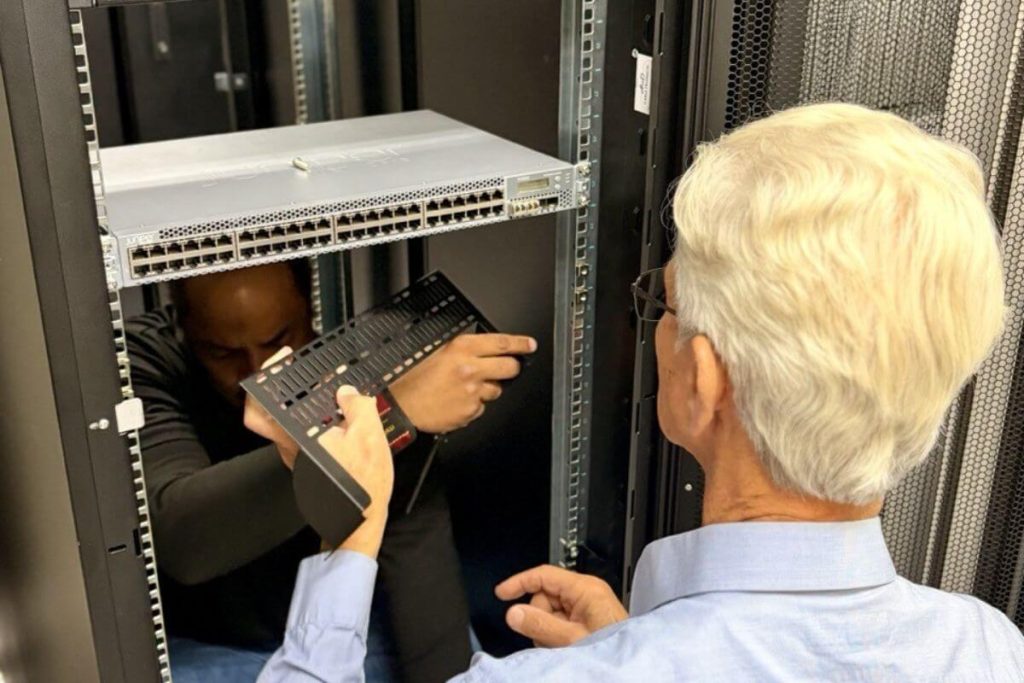
One of the most overlooked opportunities is the rack space occupied by traditional horizontal cable managers.
Conventional horizontal managers may consume one or more rack units between groups of equipment. They help organize cables, but every rack unit used for cable management is a rack unit that cannot hold servers, switches, storage, or other active equipment.
Across one cabinet, that loss may seem minor.
Across dozens or hundreds of cabinets, it can represent a significant amount of stranded capacity.

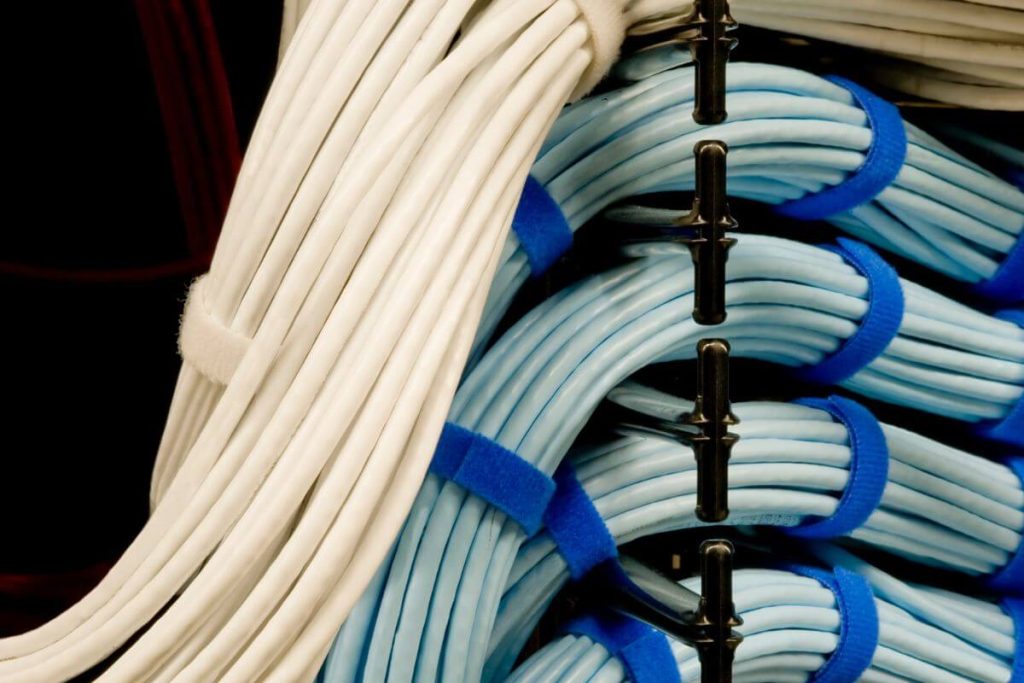
AnD Cable Products’ Zero U Cable Managers mount in the same U-space as the active device rather than occupying separate vertical mounting positions. This preserves usable rack units while still providing structured cable routing. Read more about their features and benefits.
Depending on the configuration, AnD Horizontal Zero U Cable Managers can recover 25% to 30% of rack space currently occupied by conventional cable management.
That can be roughly equivalent to gaining the usable capacity of another cabinet for every three optimized cabinets.
The facility does not become physically larger.
The existing racks become more useful.
How Rack Optimization Can Reduce the Facility Footprint
Recovering rack space does not make every expansion project unnecessary.
A facility may still be constrained by power availability, cooling capacity, structural loading, network architecture, redundancy, or equipment weight. Those limitations must be evaluated before increasing density.
However, better rack utilization can change when and how expansion becomes necessary.
Consider an environment where traditional cable managers and inefficient rack layouts force a deployment to occupy four cabinets. If Zero U cable management allows the same amount of equipment to be installed and serviced effectively across three cabinets, the operator has reduced the cabinet footprint of that deployment by 25%.
Apply that approach across multiple rows and deployment phases, and the impact becomes more meaningful.
Fewer cabinets can mean:
- Less floor space required for the same equipment
- Fewer cabinet frames and related components
- Shorter cable pathways
- Less aisle space dedicated to additional rows
- More usable capacity within an existing data hall
- A longer interval before another room or building is required
The real value is not merely fitting more equipment into a smaller area. It is reducing the amount of new data center building space required to support future growth.
An operator that recovers enough capacity from existing racks may be able to deploy another project without opening a new row. A facility may postpone a data hall buildout. A campus may extend the useful life of an existing structure before requesting additional land.
Optimization at the rack level can influence decisions far beyond the rack.
Cable Management Matters More as Racks Get Denser
Removing conventional horizontal cable managers from usable U-space should not mean sacrificing cable organization.
In fact, denser racks make cable management more important.
More equipment creates more network and power connections. Without clear pathways, those cables can obstruct access, interfere with airflow, strain connectors, and make routine maintenance more difficult.
The National Renewable Energy Laboratory recommends wire management and airflow optimization as part of an efficient data center strategy.
This is the difference between useful density and unmanaged congestion.
A properly designed Zero U cable management system can help teams:
- Route cables without consuming separate rack units
- Keep cable bundles away from critical airflow paths
- Maintain cable bend-radius requirements
- Separate and identify connections
- Access equipment without disturbing unrelated cables
- Preserve cleaner pathways for future changes
The goal is not to pack the rack until there is no room left.
The goal is to use the rack more intelligently.
A Green Data Center Should Use Space Efficiently
A green data center is often discussed in terms of renewable energy, cooling efficiency, water consumption, and Power Usage Effectiveness.
Those factors are important, but sustainability also includes how efficiently the facility uses land, materials, floor space, cabinets, and supporting infrastructure.
A data center that requires fewer cabinets for the same amount of equipment may use fewer cabinet frames, shorter cable runs, less aisle space, and fewer supporting components. If optimization postpones the need for another data hall or facility, it may also reduce the materials and construction activity associated with expansion.
This principle supports a broader green IT data center strategy:
Use existing infrastructure more effectively before adding more of it.
Optimization will not eliminate the environmental impact of data centers. It can, however, help prevent avoidable waste.
A facility should not claim to be efficient only because it purchases cleaner power. It should also ask whether its physical infrastructure is organized to deliver the most useful capacity from the space and materials already in place.
Optimization Is Not a Substitute for Community Engagement
A smaller physical footprint does not erase every concern communities have about data centers.
Electricity demand remains significant. Cooling systems may require water. Backup generation can create noise and emissions. Construction can affect roads, surrounding land uses, and local services.
Communities still deserve clear information about these impacts.
Optimization should not be used as an excuse to avoid those conversations.
It should be part of the response.
A developer that can demonstrate better use of land and infrastructure has a stronger story to tell than one whose only growth plan is to build outward. The operator can show that it is actively working to reduce unnecessary cabinets, avoid wasted floor space, improve airflow, and extend the life of existing facilities.
Better architectural design can help a data center fit visually into a community.
Better optimization can reduce how much facility the community must accommodate in the first place.
The two strategies should work together.
Look Inward Before Building Outward
Data center construction companies play an essential role when new infrastructure is genuinely required.
Optimization is not an argument against construction. It is an argument for making sure construction is necessary.
Before approving another row, room, data center building, or campus, teams should perform a capacity review that goes beyond vacant floor area.
They should ask:
- How much usable rack space is being consumed by conventional cable management?
- Are cabinets full because of active equipment or because of inefficient layouts?
- Can existing racks safely support greater density?
- Are power and cooling resources stranded by poor equipment placement?
- Can cable routing be improved without reducing serviceability?
- Could an optimization project postpone the next physical expansion?
- Has obsolete cabling or equipment been removed?
- Can a planned deployment be consolidated into fewer cabinets?
These questions do not assume that expansion is always avoidable.
They ensure that expansion is justified.
A new building should solve a genuine capacity limit. It should not compensate for preventable inefficiency inside the existing facility.
Grow the Data Center by Optimizing What Is Already There
The future of data center development will require better architecture, smarter energy planning, more thoughtful community relationships, and greener construction practices.
It will also require operators to extract more value from existing infrastructure.
Working with AnD Cable Products, data center teams can reorganize cable pathways, recover usable rack units, improve airflow conditions, and support denser equipment layouts without sacrificing accessibility.
Zero U Cable Managers are one practical example of optimization over expansion. By mounting cable management within the same U-space as active equipment, they can recover 25% to 30% of rack space that may otherwise be consumed by conventional horizontal managers.
That recovered capacity can help reduce the number of cabinets required for a deployment, extend the useful life of an existing data hall, and postpone the cost and disruption of physical expansion.
The industry will still need new facilities. Demand is too large for optimization alone to absorb.
But every new square foot should be necessary.
Before constructing another room, adding another row, or requesting another parcel of land, look inside the racks.
The capacity you need may already be there.
About the Author – John Lester

John Lester, General Manager at AnD Cable Products, brings a rich tapestry of IT and project management experience to the forefront of cable management solutions for data centers. His career, spanning over three decades, includes significant roles in IT project management and consultation with renowned companies. John served in the Marine Corps during Desert Storm. John’s journey in the tech world is further distinguished by his proficiency in advanced programming and systems expertise.
His leadership at AnD Cable Products encapsulates a blend of innovation, strategic planning, and a relentless commitment to delivering excellence in the field of data center infrastructure. John was with AnD Cable Products when Louis was designing his innovative Zero U cable management racks and Unitag cable labels, both of which have become industry-leading network cable management products. AnD Cable Products only offer products that are intelligently designed, increase efficiency, are durable and reliable, re-usable, easy to use or reduce equipment costs. He is the co-author of the Cable Management Blog, where you can find network cable management ideas, server rack cabling techniques and rack space saving tips, data center trends, latest innovations and more. Visit https://andcable.com or shop online at https://andcable.com/shop/
Frequently Asked Questions
How much does it cost to build a data center?
The cost depends on the facility’s location, size, power capacity, cooling system, redundancy requirements, security, intended rack density, and utility infrastructure. Large facilities require substantial investment before servers and networking equipment are installed. Optimizing existing rack space may postpone part of that expense by extending the capacity of the current site.
How long does it take to build a data center?
The timeline varies depending on site selection, permitting, utility connections, equipment availability, labor, construction complexity, and commissioning requirements. A new data center building may take years to move from planning to full operation. Rack-level optimization can provide additional capacity while a larger construction project is being evaluated or completed.
Can a data center add capacity without expanding the building?
Yes, in some cases. Operators may recover capacity through rack consolidation, equipment refreshes, better power utilization, improved cooling, removal of obsolete equipment, and more efficient cable management. Physical expansion may still be required when power, cooling, structural, or redundancy limits have been reached.
What is Zero U cable management?
Zero U cable management places cable-routing hardware within the same U-space as active equipment rather than occupying separate vertical rack units. This preserves usable rack space for servers, switches, storage, and other equipment while maintaining organized cable pathways.
How can Zero U Cable Managers reduce a data center’s footprint?
By recovering rack units that would otherwise be occupied by traditional horizontal cable managers, Zero U systems can allow more equipment to fit within each cabinet. In suitable configurations, this may reduce the number of cabinets needed for a deployment and postpone the need for additional rows or data halls.
Does higher rack density create cooling problems?
It can. Higher density concentrates more power and heat within each cabinet. Operators must verify that the facility’s power distribution, airflow, cooling equipment, floor loading, cable routing, and maintenance procedures can support the denser configuration.
What makes a green data center?
A green data center aims to reduce energy use, carbon emissions, water consumption, material waste, and other environmental impacts. Efficient use of rack space and existing infrastructure can contribute by reducing unnecessary cabinets, construction, and physical expansion.
How much rack space can AnD Zero U Cable Managers recover?
AnD Cable Products states that its Horizontal Zero U Cable Managers can recover approximately 25% to 30% of rack space currently occupied by conventional cable management. Actual results depend on the rack layout, equipment configuration, and type of cable managers being replaced.