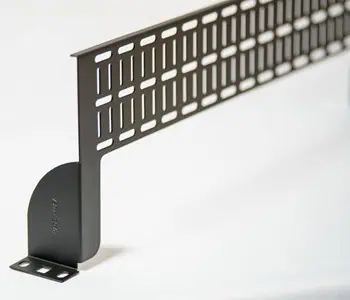
One rack unit is easy to overlook. At just 1.75 inches of vertical space, sacrificing a single U for cable management may seem inconsequential within an individual server rack. In many environments, it has historically been treated as a reasonable tradeoff for keeping patch cords organized and equipment accessible.
The calculation changes, however, when the same design decision is repeated across an entire data center.
If 1U of usable rack space is consumed in each of 100 cabinets, the facility has effectively allocated 100U to something other than active equipment.
That is more vertical mounting space than two complete 42U racks can provide.
This is why seemingly minor rack-level decisions deserve to be evaluated at scale. A small inefficiency repeated hundreds of times can eventually become a capacity issue.
Key Takeaways
- Losing just 1U across 100 racks represents 100U of unavailable equipment space.
- Traditional horizontal cable managers can consume valuable rack units throughout a data center.
- A Zero U cable manager allows cable organization to be maintained without requiring the same dedicated U-space.
- Zero U cable management becomes increasingly valuable as the number of racks and equipment density increase.
The Difference Between 1U and 100U
Within a single rack, 1U rarely appears significant enough to influence broader planning decisions. The challenge is that data center infrastructure is built around repeatable standards.
A rack configuration designed for one cabinet may eventually be deployed across an entire row, room, or facility. When every rack follows the same layout, every inefficiency in that layout is also repeated.
If one rack sacrifices 1U, the effect is minimal. Across 10 racks, that becomes 10U. Across 50 racks, it becomes 50U. Across 100 racks, the cumulative loss reaches 100U.
For comparison, a standard 42U cabinet provides 42 rack units of vertical mounting capacity. In purely spatial terms, 100U represents more than two complete racks of potential mounting space.
Real-world capacity planning is more complex, of course. Power availability, cooling, weight, redundancy, airflow, and serviceability determine how much equipment can actually be installed. Still, the underlying principle remains important: rack space is finite, and every U allocated to passive infrastructure is unavailable for servers, switches, storage, or other active hardware.
The more useful question is therefore not whether 1U matters. It is how many times that 1U is being repeated.
Traditional Cable Management Has a Physical Cost
Horizontal cable managers serve an important purpose. They provide structured routing, reduce cable clutter, and make patching and maintenance easier.
The issue is not whether cable management is necessary. It is whether that cable management needs to consume dedicated rack units.
Conventional horizontal cable managers are commonly mounted between active devices. Depending on the rack configuration, several may be installed throughout a single cabinet. Each one occupies space that could otherwise be available for equipment.
In lower-density environments, this tradeoff may be relatively easy to absorb. As rack density increases, however, that available space becomes progressively more valuable.
Modern data centers are being asked to support more compute, faster networking, greater power density, and increasingly complex equipment configurations within the same physical footprint. Under those conditions, preserving rack capacity becomes part of the broader efficiency discussion.
That is where Zero U cable management offers a different approach.
What a Zero U Cable Manager Changes
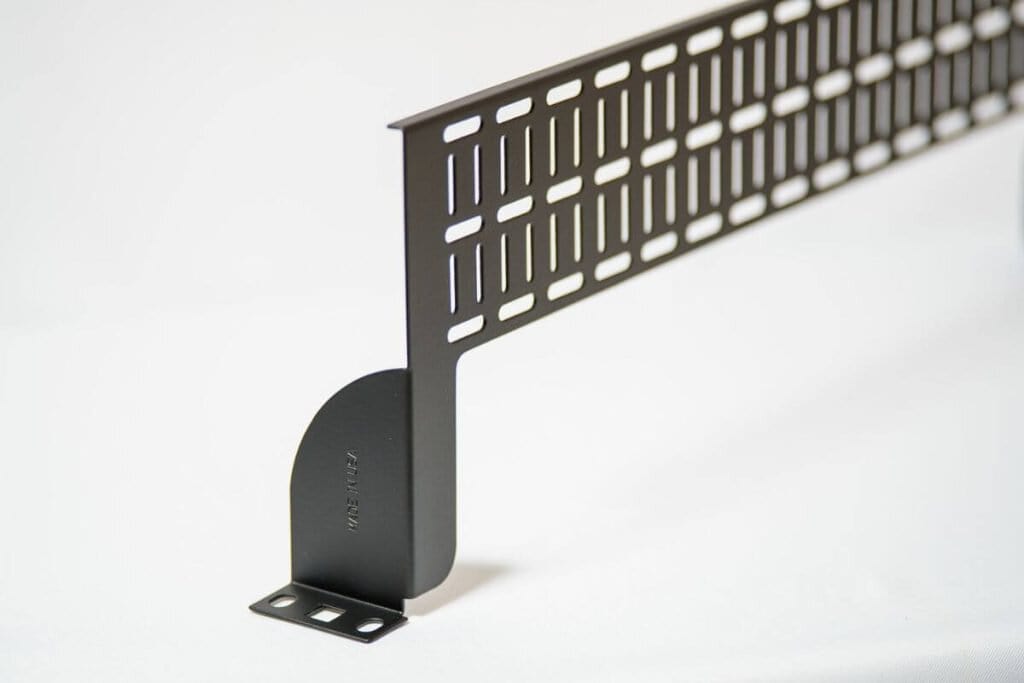
A Zero U cable manager is designed to provide structured cable routing without requiring a separate rack unit solely for cable management.
Instead of dedicating additional U-space between equipment, Zero U solutions allow cable management to be integrated alongside the active device or positioned outside the conventional equipment mounting area.
This allows the rack to perform two functions at once: maintain organized cabling while preserving more of its vertical capacity for active hardware.
For one cabinet, the improvement may appear modest. Across a large deployment, the cumulative effect can become significant.
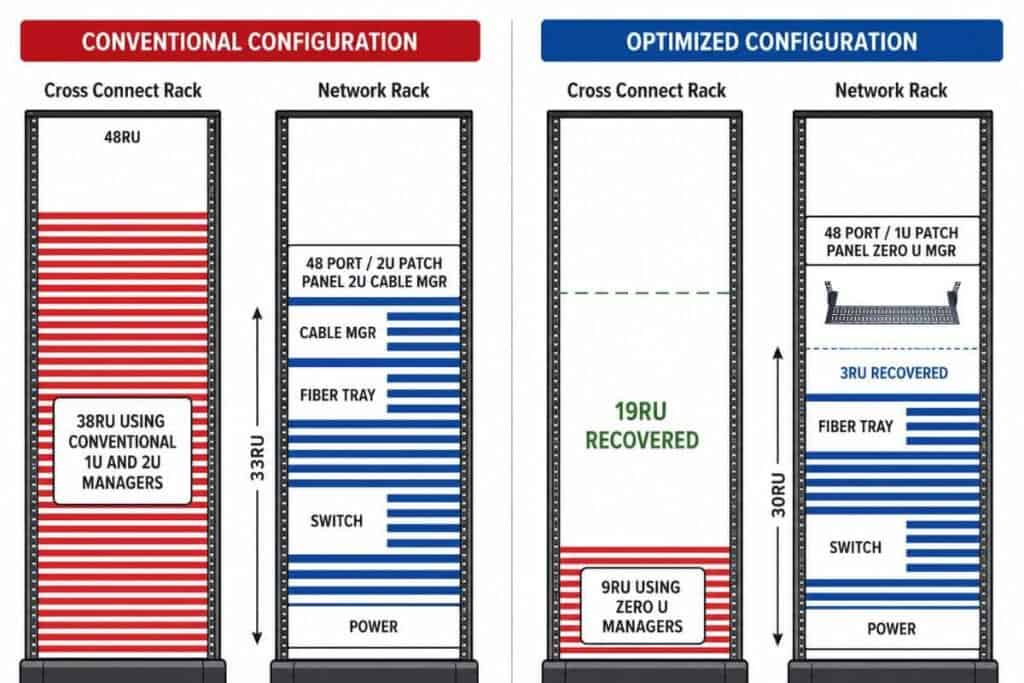
AnD Cable Products’ Zero U Cable Managers are designed around this principle. Depending on the rack configuration, they can help recover up to 30% of rack real estate that may otherwise be consumed by conventional cable management.
The value is not simply the space saved by one manager. It is what happens when the same space-saving approach is applied consistently across dozens or hundreds of cabinets.
Zero U Cable Management Becomes More Valuable at Scale
A useful way to evaluate Zero U cable management is to separate the rack-level benefit from the facility-level benefit.
At the rack level, the objective is straightforward: preserve usable U-space while maintaining organized cable pathways.
At the facility level, the potential impact is larger. Recovering space across many racks may allow a deployment to use fewer cabinets, provide additional room for future equipment, or extend the useful capacity of an existing data hall.
This is particularly important because the real cost of adding capacity is rarely limited to the price of the rack itself. Another cabinet can also require floor space, power distribution, network connections, cabling, cooling capacity, installation labor, and ongoing maintenance.
If better rack utilization allows even part of that expansion to be postponed, the value of the recovered U-space extends well beyond the cabinet.
This is why Zero U rack cable management should be viewed as more than a housekeeping improvement. In the right environment, it becomes part of capacity planning.
Higher Density Still Requires Good Infrastructure
Recovering rack space does not mean that every available U should automatically be filled.
Higher rack density increases power concentration, heat output, cable volume, equipment weight, and maintenance complexity. Any move toward denser deployments must therefore be supported by appropriate cooling, power distribution, airflow management, structured cabling, and operational procedures.
Cable management becomes more important, not less, as density increases.
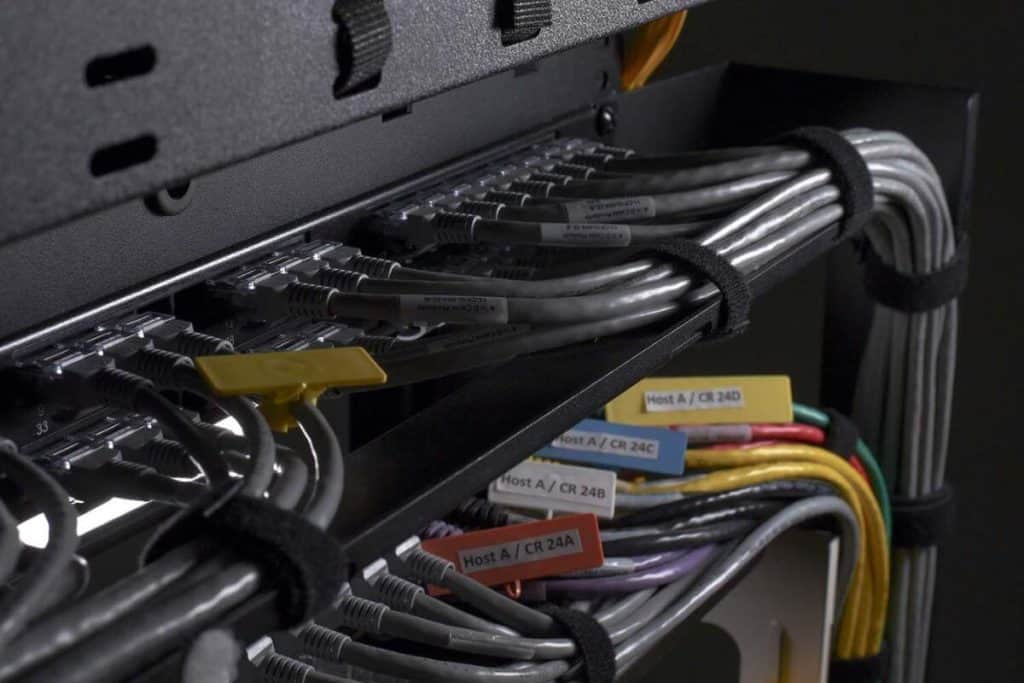
A properly designed horizontal Zero U cable manager should preserve cable organization while keeping pathways accessible and reducing unnecessary congestion. Technicians still need to be able to trace connections, replace equipment, perform adds and changes, and access devices without disturbing unrelated cables.
The goal is not maximum density at any cost. The goal is to recover space without compromising serviceability.
That distinction matters. Capacity is only useful when the infrastructure remains manageable.
Small Improvements Become Significant When Repeated
Data center planning naturally focuses on large numbers: megawatts of power, thousands of square feet, hundreds of racks, and millions of dollars in capital investment.
Yet some of the most effective optimization opportunities begin with much smaller measurements.
One rack unit is a good example.
Within a single cabinet, it is unlikely to change the economics of a facility. Across 100 cabinets, however, that same 1U becomes 100U. If multiple rack units can be recovered within each cabinet, the difference grows considerably.
This is the broader lesson behind Zero U cable management. Its value comes from eliminating a small recurring use of space and multiplying the benefit across the deployment.
The improvement happens one rack at a time, but the result should be measured at the facility level.

Look at the Rack Before Adding Another One
When evaluating existing rack configurations, data center teams should look beyond whether the current equipment simply fits.
They should also consider how much of each rack is being consumed by supporting infrastructure and whether some of that space can be recovered without compromising operations.
If conventional cable management is occupying dedicated U-space throughout a facility, a Zero U cable manager provides an opportunity to reconsider that layout.
For AnD Cable Products, this is the practical value of Zero U cable management: organize the cabling without automatically giving up the rack capacity that supports future growth.
One rack unit by itself is not much.
Across 100 racks, it is 100U of space.
At that point, it is no longer just a cable management decision. It is a capacity decision.
Frequently Asked Questions
What is a Zero U cable manager?
A Zero U cable manager organizes and routes network or power cables without requiring a separate rack unit solely for cable management. This helps preserve more usable vertical rack space for active equipment.
What is Zero U cable management?
Zero U cable management is an approach to organizing cables while minimizing or eliminating the dedicated U-space traditionally consumed by horizontal cable managers. It can help improve rack utilization while maintaining structured cable pathways.
How much space can a Zero U cable manager recover?
The amount depends on the existing rack configuration and the number of conventional cable managers being replaced. AnD Cable Products’ Zero U Cable Managers are designed to recover up to 30% of rack real estate in suitable configurations.
Why does losing 1U matter in a large data center?
Losing 1U in one rack has limited impact. Losing 1U across 100 racks results in 100U of unavailable mounting capacity, which is more than the vertical space provided by two standard 42U racks.
Does Zero U cable management support higher rack density?
It can help preserve additional rack units for equipment, which may support denser configurations. However, increased density must still be supported by sufficient power, cooling, airflow, structural capacity, cable routing, and maintenance access.
About the Author
 Louis Chompff – Founder & Managing Director, AnD Cable Products
Louis established AnD Cable Products – Intelligently Designed Cable Management in 1989. Prior to this he enjoyed a 20+ year career with a leading global telecommunications company in a variety of senior data management positions. Louis is an enthusiastic inventor who designed, patented and brought to market his innovative Zero U cable management racks and Unitag cable labels, both of which have become industry-leading network cable management products. AnD Cable Products only offer products that are intelligently designed, increase efficiency, are durable and reliable, re-usable, easy to use or reduce equipment costs. He is the principal author of the Cable Management Blog, where you can find network cable management ideas, server rack cabling techniques and rack space saving tips, data center trends, latest innovations and more.
Visit https://andcable.com or shop online at https://andcable.com/shop/