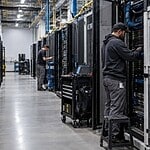
Data centers are moving away from under floor cooling and cabling, and in many cases to overhead cables and more advanced cooling systems. At the same time, what may seem the simplest of things, power cables, are evolving and changing as well. The reasons are quite simple. New angles, new cable types, and even new connection types are designed to ensure maximum uptime, no cable failures and the prevention of disastrous accidental disconnects or power loss.
Key Takeaways
By the end of this article, you’ll know:
- Power cable considerations to minimize power loss, improve efficiency and future-proof data centers.
- What to look for in power cables to easily trace power paths and prevent electromagnetic interference.
- The importance of proper cable management and locking connections.
Jump to Section:
- Cable Length Matters
- Choose Your Gauge
- Color Coding
- Use Shielded Power Cords
- Grab a Jacket
- Work the Angles
- Lock it Up

So what do these cables look like, and how can proper power cable usage prevent poor data center performance? Here are seven things to consider.
Cable Length Matters
In the case of power cables, the shorter the cable the better. No matter how good the power cord is, what gauge it is, or how it is insulated, aggregate power loss occurs over the length of the cord. The longer the cord, the greater the loss. In a large data center this can add up to thousands of dollars of wasted power annually.
Not only does this harm the data center’s overall power usage efficiency (PUE) but it is also harmful to the environment, increasing carbon emissions or even just diminishing efficiency in centers that rely on renewable energy sources.
Use the shortest cable you can for the application, but one that is long enough to prevent any breaks or damage caused by odd connection angles or cable stress.
Choose Your Gauge
While shorter cables are better, larger gauge cables are better than their smaller counterparts, and for good reason. First, they carry power more efficiently. Even if smaller cables might meet your needs now, moves and changes or new equipment can increase the demand on power cables.
In that case, a larger gauge cable can future proof your data center, eliminating the need to change cables later on. Larger gauge cables also run cooler, so there is no additional burden on your HVAC systems or cooling plans.
Color Coding
We often talk about color coding data center cords, but color coding and labeling power cords is just as essential for avoiding the “spaghetti mess” server we have all encountered. But there’s more. Color coding helps you trace power from equipment to source, prevents duplicate power paths, and helps prevent accidental disconnects during moves or changes.
Choosing to color code power cords now will save you a lot of time and effort later on.
Use Shielded Power Cords
Electromagnetic Interference (EMI) can be a nightmare in data centers. Unshielded data cables used in the same area as unshielded power cords can have a serious impact on data transmission and can result in data loss. Shielded power cords can reduce or even eliminate those odd “data drops” that are hard to find and isolate.
As with other power cable properties, a little foresight here can go a long way to preventing problems down the road.
Grab a Jacket
Power cables are required to be jacketed, and the type of jacket is often dictated by local regulations and building codes. There are different materials you can and often must use based on where the cord is located, how it is used, and the restriction of the use of certain materials in various areas.
The key is to know the rules where you are, work with a vendor who can get the right cables for you consistently, and pay attention if regulations were to change.
Work the Angles
The right length of cable is important, but so is the placement of equipment in relation to those cables. The wrong angle, too tight of turns, and other issues can cause cable breakage, disconnection and more. If necessary, use angled connectors and plugs.
Keep power cords tidy, angles to a minimum, and avoid crimping, bending, and tangling them with data cables.
Lock it Up
Locking connections ensure that your cables stay where they are supposed to, and stay connected. There are several different types of locks, and each serves its own purpose. Be sure any connections you have, male, female, or otherwise, are appropriately locked in place with a tight and secure connection.
This prevents accidental disconnects, power loss through slight separation or loose connection, and other common power problems.
Are you planning your data center? Making moves and changes? Or are you looking for new, long term power cord solutions? Contact us here at AnD Cable. We have the cables you need to future proof your data center and ensure maximum uptime.
Shop Our Power Cable Range
-
 A-Lock C13 C14 15A 250V Power Cord – WhiteFrom: $6.50
 -
 C20 C19 16A 250V UL, C-UL, VDE Power CordFrom: $9.00
 -
 6 Feet Right Angled 18/3 AWG C13 to C14 10A 250V Power Cord – Black$12.00
 -
 C14 to C13 2x Splitter 10A 250V Power Cord – BlackFrom: $12.26
 -
 14/3 AWG C13 C14 Right Angled 15A 250V Power Cord – Black, 4 Feet$14.00
 -
 P-Lock C14 to C13 15A 250V 14AWG 105c SJT Power Cord – Blue, 7 Feet$30.24
 -
 P-Lock C20 to C19 20A 250V 12AWG 105c SJT Power Cord – Orange, 4 Feet (1.22m)$34.00
 -
 P-Lock C20 to Locking C19, 20A 12/3 SJT Power Cord – Red, 2 Feet$56.80
FAQs
What is the ideal length for a power cable?
The ideal length for a power cable is the shortest one possible that still allows for a safe connection. Using the shortest cable helps minimize power loss, improve a data center’s power usage efficiency (PUE), and reduce environmental impact.
Why are larger gauge cables better than smaller ones?
Larger gauge cables are more efficient at carrying power and can handle greater demand, which helps “future-proof” a data center. They also run cooler than smaller gauge cables, which reduces the burden on cooling systems.
How can color coding power cords benefit a data center?
Color-coding power cords helps prevent the “spaghetti mess” of tangled cables and makes it easier to trace power from equipment to its source. It also helps prevent duplicate power paths and reduces the chance of accidental disconnections during equipment changes.
Why is using shielded power cords important?
Shielded power cords are crucial because they reduce or eliminate electromagnetic interference (EMI). This interference can be caused by unshielded data and power cables being in close proximity, which can lead to data loss or “data drops.”
Why is it important to pay attention to cable angles and placement?
The placement of power cables and equipment is critical because incorrect angles or tight turns can cause cable breakage and disconnections. Using angled connectors and keeping cables tidy and untangled can help prevent these issues.
About the Author
 Louis Chompff, Founder & Managing Director, AnD Cable Products
Louis established AnD Cable Products – Intelligently Designed Cable Management in 1989. Prior to this he enjoyed a 20+ year career with a leading global telecommunications company in a variety of senior data management positions. Louis is an enthusiastic inventor who designed, patented and brought to market his innovative Zero U cable management racks and Unitag cabel labels, both of which have become industry-leading network cable management products. AnD Cable Products only offer products that are intelligently designed, increase efficiency, are durable and reliable, re-usable, easy to use or reduce equipment costs. He is the principal author of the Cable Management Blog, where you can find network cable management ideas, server rack cabling techniques and space saving tips, data center trends, latest innovations and more.
Visit https://andcable.com or shop online https://andcable.com/shop/