
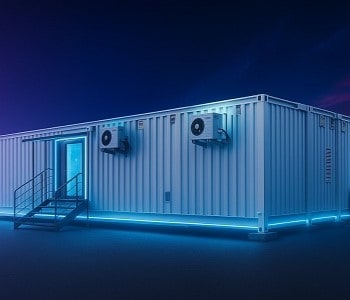
Choosing between a containerized data center and a traditional, stick-built facility isn’t a religious debate: it’s a fit decision. Do you value speed and chunked growth more, or do you need deep customization and a thirty-year canvas?
The honest answer for most organizations is “some of both,” connected by a cabling discipline that keeps airflow clean, incidents short, and capacity exactly as planned.
Key Takeaways
By the end of this article, you’ll know:
- What a Containerized Data Center is and its advantages.
- The advantages of traditional data Centers
- The financial considerations of deciding between containerized vs Traditional Data Centers.

Aligning on Terms First: Modular vs. Containerized
“Modular” is the umbrella: prefabricated building blocks (power skids, cooling pods, IT enclosures) built off-site and assembled quickly on-site. If you’re interested in learning more, read our article on modular data centers and how they accelerate deployments from 18 months to 3 months.
“Containerized” is a specific modular form factor: an ISO 20- or 40-foot container with IT (and often power and cooling) integrated in the box. Every containerized system is modular, but not every modular system is a shipping container.
Containerized Data Center vs. Traditional Data Center
Now that the difference between modular and containerized is clear, let’s compare containerized data centers vs. traditional data centers.
Containerized: Plug-in Speed, Repeatable Outcomes
You prep a pad, bring power and fiber to it, crane in a factory-tested module, and commission in weeks, not years. The messy middle shrinks: fewer trades on site, fewer inspection dependencies, fewer unknowns. When demand rises, you add another module and mirror the SOPs you already wrote. That rhythm – buy capacity in steps, monetize sooner – quietly strengthens the business case even when $/MW looks similar on paper.
Best when: demand is unpredictable, sites are constrained, proximity to users/sensors matters, you need capacity now, or you want to stage growth in clean, repeatable blocks.
Traditional: Maximum Freedom, Deliberate Pace
You get full control: aisle geometry, UPS topology, specialty rooms, liquid zones, security domains. If you reserved white space and upstream power, growing inside the hall can be elegant. If not, expansions tug at everything (HVAC, electrical, pathways) while production stays live. The payoff is deep customization and long service life, but the journey is longer, and it sometimes can be unpredictable.
Best when: you have specific, high-density requirements, long-term integration goals, specialized cooling/power needs, or you’re building a flagship facility.
If you’re a university or an institution, our University Data Center Dilemma article may provide better insights for you.
Cost Dynamics
Containerized Cost: Time-to-Value
Asking for a single “containerized data center cost” is like asking the price of a “car.” Density per rack, cooling method, climate, power path, integration scope, and logistics are variables that affect the total. What’s consistent is cash flow timing: you’re producing value months earlier and you’re not paying for empty white space “you’ll fill later.”
That shift is where containers or modular data centers often win in the real world. You have the option to buy a car that you’ll use right away, and when you need more, you buy more. Period.
Traditional Cost: Big Upfront but Powerful
Stick-built facilities are a heavy capital expenditure commitment: land, shell, MEP, and the associated carrying costs. They shine at scale and when you fully use what you built. But mis-forecasting demand is expensive: overbuild and you have idle capacity; underbuild and you throttle growth.
Early Deployment Value
Going live earlier lets you start earning earlier. Think of capacity like seats you can rent each month. If you have 1,000 “seats” and you open 12 months sooner, you sell 12 extra months of rentals, that’s where the value comes from. Even a 3-6 month head start brings in cash while you finish the rest of the build, helps fund the next module, and keeps finance happy. Swap in your own monthly rate per kW and the months you can save, and you’ll see the same pattern—earlier opening, earlier income.
Baseline example (adjust as needed):
- Sellable IT load: 1 MW (1,000 kW)
- Value per kW-month: $150
- Acceleration: 12 months
Math: 1,000 × 12 × $150 = $1,800,000 in earlier revenue.
That’s $150,000 per month brought forward.
Quick sensitivity (1 MW)
| Months Early | $120/kW-mo | $150/kW-mo | $200/kW-mo |
| 6 | $720,000 | $900,000 | $1,200,000 |
| 12 | $1,440,000 | $1,800,000 | $2,400,000 |
| 18 | $2,160,000 | $2,700,000 | $3,600,000 |
Efficiency and Airflow: Design + Discipline
Modern designs, whether containerized data center or traditional, can achieve excellent data center efficiency. The difference is how you protect it day-to-day. In a container’s tight thermal envelope, bad cabling practices bite faster: tangled fronts, service loops, and slack nests recirculate warm air and force fans to work harder. In a big room, you can hide those sins longer, but you still pay in hotspots, noise, and maintenance pain.
This is where cabling discipline pays compound interest:
- Keep the intake surface open. Move bundles to the sides, not across server faces.
- Right-size patch lengths. A 10-ft cord for a 3-ft hop is a tiny dam across your cold aisle.
- Use soft ties. Velcro cable managers prevent jacket crush and micro-bends, and it makes MAC work reversible.
- Separate A/B power clearly. Label cables so nobody hesitates at 2 a.m.
- Prefer thinner media where it makes sense. High-density fiber and 28 AWG copper reduce cable bulk and improve airflow.
With our Zero U Cable Managers, teams routinely recover up to 30% of rack U-space they would have lost to 1RU managers and slack storage. That reclaimed space improves intake area, simplifies service, and lets you keep the density you paid for, especially inside containers. Pair that with Velcro Cable Managers and our Ultimate Data Center Cable Labeling System, and you now have a more robust, reliable, and efficient setup.

Deployment and Scalability
Containerized: Compress and Clone
- Parallelization: Factory integration/testing happens while you prep the pad and utilities.
- Commissioning speed: Arrive, land, tie-in, test; your runbook is mostly repeatable.
- Scaling: Add another module, mirror the pattern, and go live. Eliminate re-learning the job.
Traditional: Full Customization and Control
- Custom fit: Tune aisle widths, liquid zones, UPS/battery strategy, and specialty rooms.
- Growth inside the hall: Elegant when planned; disruptive if upstream capacity or white space is tight.
Neither approach is “better” in the abstract. It’s a question of risk preference: speed and chunked growth vs. bespoke control and long-term integration.
Where Traditional Still Wins
If you need specialized liquid cooling, unusual security separation, or a very specific electrical topology, a purpose-built hall is still the best canvas. But space doesn’t fix messy habits; it only hides them. Larger aisles and overhead trays make it easier to delay the work, not cheaper to undo it. The fundamentals don’t change:
- Keep intake surfaces clear.
- Keep routes predictable and documented.
- Label power so nobody hesitates.
- Design for the tech and the humans who service it.

Market Context: Containerized Adoption in Numbers
To keep the cost discussion grounded, here’s where containerized data center demand is concentrated, what formats buyers choose, and which organizations are driving purchases. All figures are percentages and rounded for clarity.
Regional Demand Snapshot: Containerized Data Centers
This shows where containerized solutions are being adopted most.
| Region | 2021 | 2022 | 2023 |
| North America | 40% | 39% | 38% |
| Europe | 32% | 32% | 32% |
| Asia Pacific | 22% | 23% | 23% |
| Latin America | 4% | 4% | 4% |
| Middle East & Africa | 3% | 3% | 3% |
What it means: North America leads in absolute spend. Asia Pacific is rising quickly as organizations add edge and new-build capacity where power and permits are available.
What Buyers Are Deploying: By Container Type
This breaks the market down by common container formats.
| Container Type | 2021 | 2022 | 2023 |
| 20-Foot | 32% | 33% | 34% |
| 40-Foot | 48% | 47% | 46% |
| Customized | 20% | 20% | 20% |
What it means: 40-foot units dominate because they balance density and serviceability. Customized builds are growing for sites with unique cooling or power needs.
Who’s Buying: By Organization Size
This gives a quick view of which teams are driving purchases.
| Organization Size | 2021 | 2022 | 2023 |
| SMEs | 37% | 38% | 39% |
| Large Organizations | 63% | 62% | 61% |
What it means: Large organizations still drive most spend, but SME share is rising, consistent with stepwise, modular expansion.
AnD Cable Products analysis of a third-party sample market dataset (2021–2023). Figures are transformed to percent share and approximate year-over-year growth and rounded; scope limited to containerized data centers; totals may not equal 100% due to rounding.
Which One Is for You
Choosing between a containerized data center and a traditional one is a “fit-for-you” decision. Containers excel at speed, predictable rollout, and stepwise scaling; traditional builds deliver deep customization, integrated plants, and a long service life. Many organizations today blend both.
Make the call by mapping workloads and timelines, confirming power availability and site constraints, setting target rack densities and cooling envelopes, and deciding how much customization you truly need.
Align budget with risk: time-to-value vs. upfront CapEx. Whatever you choose, protect efficiency and uptime with disciplined cabling: keep intakes clear, right-size patch lengths, use hook-and-loop ties, separate and label everything, and document routes. Finally, assign clear responsibility to owners for electrical, cooling, networks, and logistics. Good fundamentals make either path perform as designed.
FAQs
What is the main difference between a containerized and a traditional data center?
The core difference lies in their approach to deployment and scalability. Containerized data centers are prefabricated, modular units (often in a shipping container format) that are built and tested off-site before being transported and set up. A traditional data center is a “stick-built” facility constructed on-site from the ground up.
What are the main benefits of a containerized data center?
Containerized data centers excel at speed of deployment, predictable outcomes, and stepwise scaling. They can be commissioned in weeks or months, as opposed to the years it takes to build a traditional facility. They also allow for a “pay-as-you-grow” model, where you can add capacity as needed.
What are the main benefits of a traditional data center?
Traditional data centers offer maximum customization and deep control. They are a better choice for organizations that need a highly specialized electrical topology, liquid cooling, or unique security separation. They are also well-suited for planned, large-scale growth.
Is a containerized data center more cost-effective?
The cost comparison is not straightforward. While the initial build cost of a containerized data center can be significantly less (reportedly up to 30% less), the true cost is a matter of time-to-value. They allow you to generate revenue months earlier and avoid the high upfront capital expenditure of a traditional build, which often includes paying for unused “white space.”
Which type of data center is better for my business?
Neither is inherently “better.” The choice depends on your specific needs. Containerized data centers are ideal if you prioritize rapid deployment, predictable results, and scalable growth. Traditional data centers are the better option if your business requires full customization, has very specific needs, or is prepared for a heavy, long-term capital commitment.
About the Author – John Lester

John Lester, General Manager at AnD Cable Products, brings a rich tapestry of IT and project management experience to the forefront of cable management solutions for data centers. His career, spanning over three decades, includes significant roles in IT project management and consultation with renowned companies. John served in the Marine Corps during Desert Storm. John’s journey in the tech world is further distinguished by his proficiency in advanced programming and systems expertise.
His leadership at AnD Cable Products encapsulates a blend of innovation, strategic planning, and a relentless commitment to delivering excellence in the field of data center infrastructure. John was with AnD Cable Products when Louis was designing his innovative Zero U cable management racks and Unitag cable labels, both of which have become industry-leading network cable management products. AnD Cable Products only offer products that are intelligently designed, increase efficiency, are durable and reliable, re-usable, easy to use or reduce equipment costs. He is the co-author of the Cable Management Blog, where you can find network cable management ideas, server rack cabling techniques and rack space saving tips, data center trends, latest innovations and more. Visit https://andcable.com or shop online at https://andcable.com/shop/


