

As someone involved in running or growing an academic institution, you’ve probably noticed that the role of technology has changed dramatically. These days, robust and reliable IT infrastructure isn’t just important—it’s essential. Your ability to attract students, deliver advanced research, and even secure funding increasingly depends on your digital capabilities. This reality puts a critical decision on your desk: Should your university data center grow by building, buying, or opting for modular solutions?
This article helps you navigate this decision clearly and objectively, weighing the advantages and drawbacks of each option. We’ll also introduce a flexible third alternative—modular data centers—which might offer exactly the balance you need.
Key Takeaways
By the end of this article, you’ll know:
- What the “build or buy” dilemma is.
- The options Universities have and their trade offs.
- The hybrid approach to solving the dilemma that many universities are taking.

Why Data Centers Matter More Than Ever for Universities
Today’s universities generate enormous volumes of data. You handle student information, academic research, sensitive health data, and resource-intensive applications like artificial intelligence and high-performance computing. The growing demand for online courses, cloud-based services, and high-bandwidth research tasks further intensifies these needs.
Consider Stanford University’s High-Performance Computing Center, which powers groundbreaking research in AI and machine learning. Or take the University of Chicago, whose dedicated POD-A facility ensures strict compliance with federal regulations like HIPAA and FERPA. These universities illustrate a simple but powerful point: Institutions serious about growth and innovation recognize that data infrastructure directly impacts their success.
If you’re aiming to expand your college into a university or looking to elevate your existing institution, strong IT infrastructure isn’t optional—it’s strategic.
Understanding the Current University Data Center Landscape
To appreciate the importance of this decision, it’s helpful to understand just how common dedicated data centers are in higher education. Across the U.S., hundreds of institutions—from prestigious research universities like MIT and Cornell to multi-campus community colleges—operate their own physical data centers.
University Data Center List
Here’s a list of well-known universities with data centers in the U.S.
| University | Data Center Type | Focus | Description | Link |
|---|---|---|---|---|
| Auburn University | FSRDC | Federal Research Data | Partner in the Atlanta RDC consortium, providing secure access to non-public federal microdata for research. | Census Bureau – Atlanta RDC |
| Clemson University | HPC / General IT | High Performance Computing & Campus IT | The Information Technology Center (ITC) is the primary data center, housing research and production systems. Recently upgraded to be a top public academic supercomputing facility. | Clemson ITC Case Study |
| Stanford University | HPC / FSRDC | AI, ML, High-Performance Computing & Federal Research Data | Operates the High Performance Computing Center (HPCC) and is a partner in the California – Stanford RDC. | Stanford HPCC |
| University of Texas at Austin | HPC | Advanced Computing for Science & Society | Texas Advanced Computing Center (TACC) designs and operates some of the world’s most powerful computing resources, enabling discoveries in science and society. | TACC Homepage |
| University of Chicago | General IT / FSRDC | Administrative, Research, & Secure Data | Operates five distinct data centers, including a Tier-2 facility for FERPA/HIPAA compliant data, and a POD-B for Research and HPC demands. Partner in the Chicago RDC. | UChicago Data Center Overview |
| University of Georgia | General IT / FSRDC | Core Campus & University System IT | Runs the 16,000 sq ft Boyd Data Center, providing professional quality support for UGA and the University System of Georgia user community. Partner in the Atlanta RDC. | UGA Boyd Data Center |
| Emory University | FSRDC | Federal Research Data | Partner in the Atlanta RDC consortium. | Emory University |
| Harvard University | FSRDC | Federal Research Data | Partner in the Boston RDC consortium. | Harvard University |
| University of California, Berkeley | FSRDC | Federal Research Data | Partner in the California – Berkeley RDC. | UC Berkeley |
| University of Illinois at Urbana-Champaign | HPC / FSRDC | Supercomputing, Advanced Computing & Federal Research Data | National Center for Supercomputing Applications (NCSA), an original NSF Supercomputer Center. Partner in the Chicago RDC. | NCSA Homepage |
| The Ohio State University | HPC / FSRDC | Supercomputing, Research Computing & Federal Research Data | Ohio Supercomputer Center (OSC) serves over 20 Ohio universities. Partner in the Kentucky RDC. | Ohio State University |
| Indiana University | General IT / FSRDC / HPC | Campus Data Centers, Server Leasing & HPC | Manages all university data centers and offers server space leasing to departments. Partner in the Kentucky RDC. Provides HPC resources. | Indiana University |
| Southern Methodist University (SMU) | General IT / FSRDC | Campus IT, Data Center Engineering & Federal Research Data | Offers an M.S. in Datacenter Systems Engineering. Partner in the Dallas-Fort Worth RDC. | SMU Homepage |
| Boston College | FSRDC | Federal Research Data | Partner in the Boston RDC consortium. | Boston College |
| Boston University | FSRDC | Federal Research Data | Partner in the Boston RDC consortium. | Boston University |
| Brown University | FSRDC | Federal Research Data | Partner in the Boston RDC consortium. | Brown University |
| Dartmouth College | FSRDC | Federal Research Data | Partner in the Boston RDC consortium. | Dartmouth College |
| Massachusetts Institute of Technology (MIT) | FSRDC | Federal Research Data | Partner in the Boston RDC consortium. | MIT Homepage |
| Northeastern University | FSRDC | Federal Research Data | Partner in the Boston RDC consortium. | Northeastern University |
| Tufts University | FSRDC | Federal Research Data | Partner in the Boston RDC consortium. | Tufts University |
| University of California, Davis | FSRDC | Federal Research Data | Partner in the California – Berkeley RDC. | UC Davis |
| University of California, San Francisco | FSRDC | Federal Research Data | Partner in the California – Berkeley RDC. | UCSF Homepage |
| University of California, Irvine | FSRDC | Federal Research Data | Partner in the California – Irvine RDC. | UC Irvine |
| University of California, Los Angeles | FSRDC | Federal Research Data | Partner in the California – Los Angeles RDC. | UCLA Homepage |
| University of Southern California | FSRDC | Federal Research Data | Partner in the California – USC RDC. | USC Homepage |
| Northwestern University | FSRDC | Federal Research Data | Partner in the Chicago RDC consortium. | Northwestern University |
| University of Notre Dame | FSRDC | Federal Research Data | Partner in the Chicago RDC consortium. | University of Notre Dame |
| Oklahoma State University | FSRDC | Federal Research Data | Partner in the Dallas-Fort Worth RDC. | Oklahoma State University |
| University of North Texas | FSRDC | Federal Research Data | Partner in the Dallas-Fort Worth RDC. | University of North Texas |
| University of Texas at Arlington | FSRDC | Federal Research Data | Partner in the Dallas-Fort Worth RDC. | UT Arlington |
| University of Texas at Dallas | FSRDC | Federal Research Data | Partner in the Dallas-Fort Worth RDC. | UT Dallas |
| Florida Atlantic University (FAU) | FSRDC | Federal Research Data | Partner in the Florida RDC. | FAU Homepage |
| Florida State University (FSU) | FSRDC | Federal Research Data | Partner in the Florida RDC. | FSU Homepage |
| University of Central Florida (UCF) | FSRDC | Federal Research Data | Partner in the Florida RDC. | UCF Homepage |
| University of Florida (UF) | FSRDC / General IT | Federal Research Data & Campus IT | Partner in the Florida RDC. ICT Data Center and Logistics Team. | UF Homepage |
| University of South Florida (USF) | FSRDC | Federal Research Data | Partner in the Florida RDC. | USF Homepage |
| American University | FSRDC | Federal Research Data | Partner in the Georgetown RDC. | American University |
| Georgetown University | FSRDC | Federal Research Data | Partner in the Georgetown RDC. | Georgetown University |
| University of Kansas | FSRDC | Federal Research Data | Partner in the Kansas City RDC. | University of Kansas |
| University of Missouri | FSRDC | Federal Research Data | Partner in the Kansas City RDC. | University of Missouri |
| University of Kentucky | FSRDC | Federal Research Data | Partner in the Kentucky RDC. | University of Kentucky |
| University of Maryland | FSRDC | Federal Research Data | Partner in the Maryland RDC. | University of Maryland |
| Michigan State University | FSRDC | Federal Research Data | Partner in the Michigan RDC. | Michigan State University |
| University of Michigan | FSRDC | Federal Research Data | Partner in the Michigan RDC. | University of Michigan |
| University of Minnesota | FSRDC | Federal Research Data | Partner in the Minnesota RDC. | University of Minnesota |
| University of Alabama | HPC | High-Performance Computing | Actively developing a new HPC facility and Enterprise Data Center, including colocation services. | UA OIT HPC Page |
| University of Arizona | General IT | Data & Digital Society Studies | Houses the Center for Digital Society and Data Studies, focusing on data management and preservation. | University of Arizona CDS |
| University of Washington | General IT | Campus IT Infrastructure | Operates the UW Tower data center, which has received ENERGY STAR certification for efficiency. | UW Sustainability – Data Center |
| University of Colorado Boulder | General IT / Research Data | Research Data & Digital Scholarship | Center for Research Data and Digital Scholarship (CRDDS) supports data infrastructure for large-scale computing and long-term storage. | UC Boulder CRDDS |
| Duke University | FSRDC | Federal Research Data | Partner in the Triangle Research Data Center (TRDC), providing secure access to non-public microdata. | Duke TRDC |
| University of Wisconsin-Madison | General IT / Research Data | Data and Information Services Center | Operates the Data and Information Services Center (DISC). | UW-Madison DISC |
| Purdue University | HPC / General IT | Research Computing & Campus IT / Colocation | Operates DataStation (a PRF-managed data center for research park) and other research computing facilities. | Purdue DataStation |
| Carnegie Mellon University | HPC / Research Data | Data Center Operations & Research | Operates the Data Center Observatory (DCO), a fully instrumented data center for research into operational costs and new technologies. | CMU Data Center Observatory |
| Columbia University | General IT / HPC | Campus IT & High Performance Computing | Data Center Facilities department supports university’s main data center and disaster recovery site, including HPC services. | Columbia CUIT Data Center |
| New York University | Research Data | Data Science Research | Houses the NYU Center for Data Science (CDS), a degree-granting graduate institute and research center. While not a “data center” in the traditional sense, it represents significant data-intensive infrastructure. | NYU Center for Data Science |
| University of Pennsylvania (UPenn) | General IT / Colocation | Campus IT Assets & Colocation Services | Provides Data Center & Colocation Solutions, with two campus locations for housing IT assets and offering secure, reliable services. | UPenn ISC Data Center |
This widespread adoption underscores that serious institutions view data centers as foundational infrastructure comparable to libraries or science buildings. But the question remains: should you build your own data center from scratch or outsource to colocation and cloud providers?
Let’s explore each of these paths in practical terms.
Option 1: Build Your Own Data Center (On-Premise)
Advantages:
- Full Control and Customization: Building your own data center means you decide exactly how it’s constructed, secured, and managed. You control data access, network performance, and security down to the smallest detail. This control is especially beneficial if your institution handles sensitive information or conducts specialized research.
- Tailored Performance: If your university has specific computing requirements—like high-density GPU clusters for AI—your own data center lets you design precisely to your needs. For example, Stanford’s HPC facility provides tailored hardware environments specifically optimized for research-intensive workloads.
- Long-term Investment: Although expensive upfront, owning your facility means you eventually pay down the capital investment, leaving you with potentially lower operating costs over the long term.
Challenges:
- Significant Capital Expenditure: Building a dedicated data center typically requires a substantial initial investment, often running into millions of dollars and taking years, before a single server is even operational.
- Ongoing Operational Costs: High energy bills, specialized maintenance, and cooling costs can add significant long-term financial commitments.
- Staffing Needs: You’ll need skilled technical staff for ongoing management, security, and troubleshooting—talent that may be difficult or costly to recruit and retain.
Option 2: Buying Capacity (Colocation or Cloud Services)
Some institutions prefer to outsource their data center needs, renting space in external facilities (colocation) or leveraging cloud providers such as AWS, Google Cloud, or Microsoft Azure. Arizona State University is one such example; they closed five smaller campus data centers and consolidated operations with Iron Mountain, a trusted colocation provider.
Advantages:
- Reduced Capital Expenditure: Outsourcing converts upfront capital expenses into predictable operating costs, freeing up resources for other strategic investments.
- Speed and Scalability: With colocation or cloud services, you can expand rapidly without waiting for construction timelines. This approach offers greater agility in responding to changing institutional needs.
- Reduced Management Burden: Maintenance, cooling, security, and power backup become the provider’s responsibility, allowing your team to focus more on strategic IT initiatives and innovation.
Challenges:
- Limited Control: Outsourcing means less direct control over security protocols, physical access, and network customization, which could complicate compliance with regulatory standards like FERPA or HIPAA.
- Variable Costs: Depending on your data usage patterns, cloud providers’ fees can fluctuate dramatically, particularly if you experience heavy, unpredictable data traffic.
- Dependency on Providers: Outsourcing introduces dependency risks—if your provider experiences downtime or issues, it directly impacts your institution.
Option 3: Modular Data Centers—A Flexible Middle Ground
Fortunately, the choice between building your own large-scale data center and outsourcing entirely is not binary. A third option—modular data centers (MDC)—has emerged as an attractive compromise.
Modular data centers are prefabricated, self-contained units delivered directly to your campus, complete with built-in cooling, power, and server racks. They’re effectively plug-and-play solutions.

Advantages:
- Incremental Scaling: You can start small and gradually expand, adding modular units as your needs grow, rather than committing to large initial investments. Utah State University deploys modular units to match increasing computing demands, scaling rapidly as needed.
- Lower Initial Costs: Modular units require significantly lower upfront investments than traditional data center construction, making them accessible even to institutions with tighter budgets.
- Rapid Deployment: Modular data centers can be operational within weeks rather than the months or years required for conventional builds.
- Energy Efficiency and Sustainability: Modern modular data centers are designed with sustainability in mind. AnD Cable Products offer modular solutions that achieve impressive energy efficiency (PUE ratings around 1.1), simplifying your sustainability initiatives and potentially unlocking additional cost savings.
Challenges:
- Some Space Still Required: While compact, modular units still require suitable on-campus space for installation.
- Management and Maintenance: Although simplified, modular data centers still require on-campus technical personnel for management, albeit at a reduced scale compared to traditional data centers.
Making the Right Choice: A Practical Decision Guide
When considering your options, ask yourself these questions:
- How sensitive is the data we manage? If you handle heavily regulated information, building your own or using modular units may be essential.
- What are our immediate and future budget constraints? If you’re budget-sensitive, colocation or modular units might align better with your financial planning.
- Do we have space available on-campus? If space is tight, colocation might be preferable, though modular units are compact enough for most campuses.
- What’s our current IT staffing situation? If staffing is limited, you might benefit from the simplified management offered by colocation or modular units rather than building from scratch.
- What are our long-term research and academic objectives? If you anticipate rapid growth in research or technology use, modular data centers offer flexible scalability without the risk of over-investing upfront.
Embracing a Hybrid Approach: Often the Ideal Solution
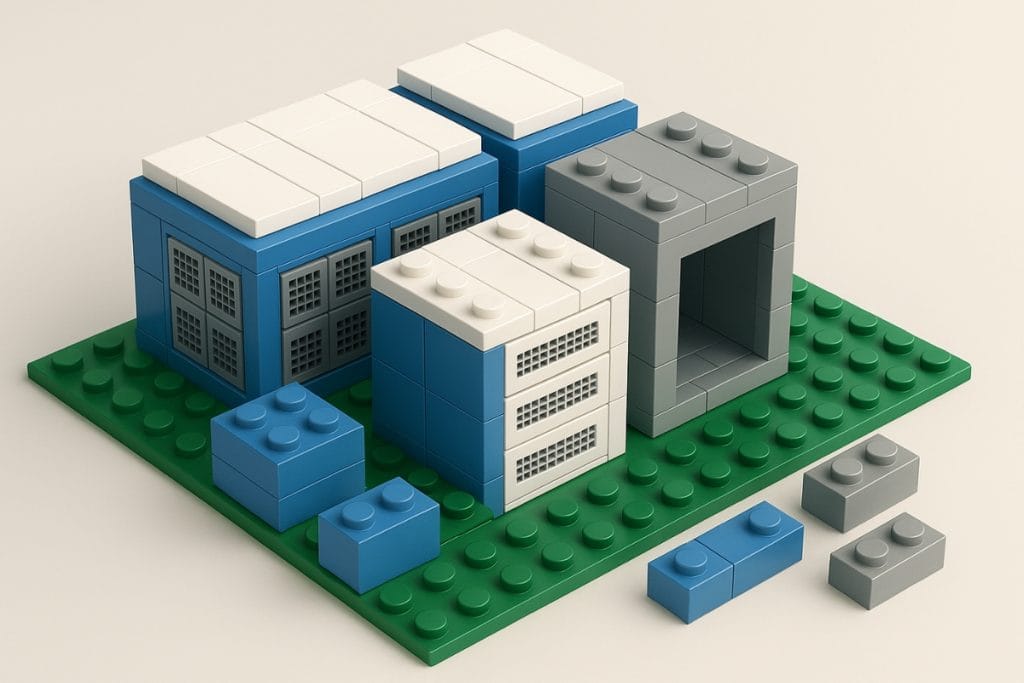
In practice, many universities combine solutions into a hybrid model. They maintain on-premises or modular data centers for critical workloads while leveraging cloud or colocation facilities for additional scalability or backup. This approach balances cost, control, and flexibility in an increasingly digital academic environment.
The Bottom Line: Decide Today for Tomorrow’s Growth
Ultimately, your institution’s growth and competitiveness depend significantly on the strategic choices you make around technology infrastructure. The question of whether to build or buy a data center isn’t just technical—it’s strategic.
Whichever direction you choose, it’s vital to decide proactively rather than reactively. Your peers and competitors are already investing in their data center infrastructure. Acting now ensures that your institution remains not only relevant but positioned for substantial growth in the future.
The digital landscape of higher education is evolving rapidly. Your next step—whether building, buying, or bridging—should be carefully considered but taken without delay.
FAQs
What is the main dilemma that universities face regarding their data centers?
The primary dilemma for universities is whether to “build or buy” their IT infrastructure. This means they must decide between building their own on-premise data center, or outsourcing their needs to colocation and cloud providers.
Why is a strong IT infrastructure so important for academic institutions?
A robust IT infrastructure is crucial for universities because they handle vast amounts of data, including student information, academic research, and sensitive health data. It is also a strategic asset that helps them attract students, conduct research, and secure funding.
What are the main advantages and disadvantages of building a data center on-premise?
Advantages: Building a data center allows for full control and customization over security and performance. It can also lead to lower long-term operating costs after the initial capital investment.
Disadvantages: The main drawback is the significant upfront capital expenditure required to build the facility.
Do many universities choose to build their own data centers?
Yes, the article notes that it is a common practice in higher education. It provides a list of numerous U.S. universities, including MIT, Cornell, and the University of Texas at Austin, that operate their own data centers.
About the Author – John Lester

John Lester, General Manager at AnD Cable Products, brings a rich tapestry of IT and project management experience to the forefront of cable management solutions for data centers. His career, spanning over three decades, includes significant roles in IT project management and consultation with renowned companies. John served in the Marine Corps during Desert Storm. John’s journey in the tech world is further distinguished by his proficiency in advanced programming and systems expertise.
His leadership at AnD Cable Products encapsulates a blend of innovation, strategic planning, and a relentless commitment to delivering excellence in the field of data center infrastructure. John was with AnD Cable Products when Louis was designing his innovative Zero U cable management racks and Unitag cable labels, both of which have become industry-leading network cable management products. AnD Cable Products only offer products that are intelligently designed, increase efficiency, are durable and reliable, re-usable, easy to use or reduce equipment costs. He is the co-author of the Cable Management Blog, where you can find network cable management ideas, server rack cabling techniques and rack space saving tips, data center trends, latest innovations and more. Visit https://andcable.com or shop online at https://andcable.com/shop/


